April 15, 2026

Guide: Why API Latency Alone Is a Misleading Metric

Brooke Grief

Head of Content

Share
  1. LI Test

  2. LI Test

That Benchmark Table Is Lying to You

You've seen it a hundred times. A vendor publishes a latency number, someone drops it in a Slack thread, the fastest option gets circled, and a decision gets made. Clean, simple, wrong.

Raw API latency—measured in a controlled benchmark with a warm cache and a single clean query—tells you almost nothing about what happens when your product is actually running. And building your API evaluation strategy around it means you're optimizing for the demo, not the deployment.

Our guide, Why API Latency Alone Is a Misleading Metric, breaks down what benchmark tables leave out and gives you the framework to make smarter, production-ready API decisions.

The Number You're Missing: Time-to-Useful-Result

The real question isn't how fast an API responds. It's how long it takes a user to get an answer they can actually act on. That composite metric—time-to-useful-result—is what shows up in your production logs. And it includes a lot more than response time.

Here's What the Guide Covers:

  • Why p50 latency is the wrong number to watch—and which tail percentiles actually reveal architectural problems like cold starts, cache misses, and throttling
  • Throughput under load—how a 400ms API can become a 2.5-second bottleneck the moment real concurrency kicks in
  • Quality-adjusted latency—why a fast, wrong answer costs more than a slightly slower, accurate one
  • The hidden latency tax—re-queries, error recovery, and ungrounded responses that never show up in a benchmark but always show up in production
  • How to test like a production engineer, not a vendor demo

Stop Benchmarking. Start Evaluating.

The teams that make good API decisions don't just check the headline number—they test at real concurrency, measure quality alongside speed, and account for the full cost of getting users to the right answer.

Download the guide and start asking better questions before your next API decision.

If you're evaluating APIs for AI search or research workflows, the You.com Search and Research APIs are built to be tested rigorously. Start with the docs or book a conversation with the team about your specific workload.

Featured resources.

Paying 10x More After Google’s num=100 Change? Migrate to You.com in Under 10 Minutes

September 18, 2025

Blog
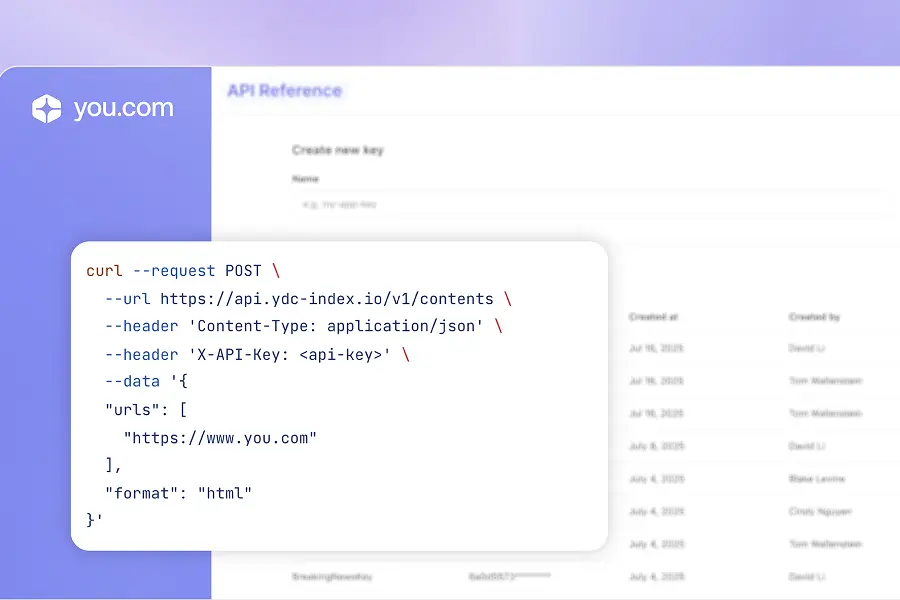
September 2025 API Roundup: Introducing Express & Contents APIs

September 16, 2025

Blog
You.com vs. Microsoft Copilot: How They Compare for Enterprise Teams

September 10, 2025

Blog

All resources.

Browse our complete collection of tools, guides, and expert insights — helping your team turn AI into ROI.
Comparisons, Evals & Alternatives

Why Your AI Search Evaluation Is Probably Wrong (And How to Fix It)

Zairah Mustahsan

Staff Data Scientist

March 10, 2026

News & Press

Measuring & Demonstrating ROI

AI for Efficiency: Where It Delivers Results and Where It Falls Short

You.com Team

March 10, 2026

Blog

Rag & Grounding AI

Why AI with Real-Time Data Matters

You.com Team

March 5, 2026

Blog

AI 101

Effective AI Skills Are Like Seeds

Edward Irby

Senior Software Engineer

March 2, 2026

Blog

Surreal collage featuring fragmented facial features layered with abstract shapes on a black‑to‑blue gradient background.
Rag & Grounding AI

AI Hallucination Prevention and How RAG Helps

Megna Anand

AI Engineer, Enterprise Solutions

February 27, 2026

Blog

Bar chart showing model accuracy on DeepSearchQA; Frontier leads at 83.67%, followed by others ranging from 81.9% down to the lowest score of 21.33%.
Product Updates

Introducing the You.com Research API—#1 on DeepSearchQA

You.com Team

February 26, 2026

Blog

A person standing before a projected screen with code, holding a tablet and speaking, illuminated by blue and purple light.
AI Agents & Custom Indexes

Why Agent Skills Matter for Your Organization

Edward Irby

Senior Software Engineer

February 26, 2026

Blog

Illustration with the text “What Is P99 Latency?” beside simple line-art icons, including a circular refresh symbol and layered geometric shapes.
Accuracy, Latency, & Cost

P99 Latency Explained: Why It Matters & How to Improve It

Zairah Mustahsan

Staff Data Scientist

February 25, 2026

Blog